



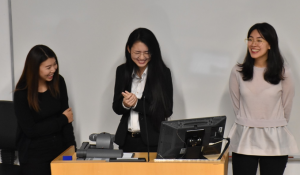
The Capstone (or Final Year) Project is a year-long project carried out independently by final-year students under the supervision of a professor. It gives our final year students the opportunity to design, research, and write an in-depth research paper on a self-chosen subject in China Studies to showcase their knowledge in theories and methods, as well as analytical skills and interests in different aspects relating to Greater China learnt from different courses.
To allow enough time to plan and carry out the Project, all final year students should take the research methods course CHES3500 in Final Year Term 1 to formulate a research proposal. Students should also approach teachers as early as possible to discuss their intended project. In Final Year Term 2, students carry out the research and write their paper in multiple drafts. They will receive feedback and comments from their instructors as well as peers, and revise their draft into a final paper.
Registration of CHES4500 will be handled by the Centre Office. Students with special requests (such as Advance Standing) should fill out the registration form for CHES3500 and CHES4500 and submit it to the Department Office before the deadline in order to avoid delays in graduation.
The Capstone Projects are formally presented in an annual Undergraduate Student Forum at the end of the academic year. Students of all years are welcome and highly encouraged to attend this Forum. This is the opportunity to learn about the projects that your fellow students have done. Come see their presentations and give them your support!
Below are some of the capstone projects our CCS students have conducted in the past few years:
2025-2026
Gender, Feminism, and Intimate Relationships
- Balancing Career and Childbearing: Fertility Strategies of Educated Middle-Class Women in Guangzhou’s Urban Villages
- The Dual Paths of Female Subjectivity in the Postfeminist Context: A Case Study of Go Lala Go! and Legally Blonde
- Higher Education, Age, and Appearance Requirements: A Comparative Analysis of Gender Discrimination in Urban China and South Korea’s White-Collar Markets
- Constructing “Her” Space: A Study of “Musical Girls (剧女)” in Shanghai
- From Emotional Outlet to Stratified Affective Infrastructure: Female Anonymous “Toilet” Communities on Chinese Social Media
- From Song Siming to Zhao Jin: The Changing Image of the Male Third Party and Women’s Compromised Progress in Chinese Popular Culture
Youth Culture, Identity, and Psychological State
- Setting Boundary: Kinship Disconnection among Contemporary Chinese Youth
- Intergenerational Reciprocity and Youth Identity: University Graduates as “Full-Time Children” in China
- How Young Adults in China Use Tarot to Navigate Uncertainty and Construct Self-Identity: An Ethnographic Study of Online and Offline Practices
- The “Sit-up” Generation: Narrative Negotiation and Identity Recovery among Middle-Class Youth in the Yangtze River Delta
- Between Mandarin and Bahasa: Language, Cultural Identity, and the Reimagining of Chineseness among Young Chinese Indonesians
- Self-expression Embedded in Embodied Experience: Identity Negotiation through Participation in K-pop Roadshow
Media, Pop Culture, and Literary Narratives
- From Action to Interiority: The Transformation of Wuxia Cinema in the Art Cinema Mode
- The Popular Logic of Chinese Micro-Short Dramas and Its Emotional Impact on Generation Z from the Perspective of Emotional Value Consumption
- Scripted Emotions: Emotional Interaction in Emotion-focused Murder Mystery Games
- Engineering Survival, Programming Life: The Paradox of Technological Governance in Liu Cixin and Chen Qiufan
- From “Place” to “Landscape”: How Influencer Filters Reconstruct Urban Spectacles in Chongqing
- Retention, Creation, and Abridgment: Eileen Chang’s Mandarin Translation of Sing-song Girls of Shanghai and the Transmission of Urban Culture
Marketing, Consumer Behavior, and Economic Trends
- A SWOT Analysis of CHAGEE’s IP Marketing Strategy from the Consumer Perspective: Taking Shenzhen’s GenZ as an Example
- How Intimate Relationships Shape Consumer Expectation in Luxury, in the Context of Lower Middle-Class Teenagers in Hong Kong
- How does Livestream Commerce on Douyin Live Increase Purchasing Intention among Chinese Female Consumers in Their 20s–30s in the K-beauty (Skincare) Sector?
- Formation of Investment Behavior towards Wealth Management Product of High Net-Worth Individuals in China
- How do Various Social Actors Interact and Affect the Motivation of Young Mainland Chinese in Participating in “Special Forces-style Tourism”?
- Refined Pet Parenting: Reshaping Intimacy and Life in Urban China
Public Governance, Law, and Policy Analysis
- Substance Use Disorder, Family Intimacy, and Social Reintegration in Hong Kong: A Qualitative Study of Relational Recovery
- Regulating China’s Webcast E-commerce: Multi-Stakeholder Governance and Adaptive Regulation
- Governing Through a Prism: How Social Media Refracts Governance Models and Influences Citizen Participation in Hong Kong and Shenzhen
- Comparing and Contrasting U.S. and China’s Antitrust Laws in Dealing with Acquihire Practices: Lessons from the AI and Tech Sectors
- Analysis of the Political and Economic Impact of Digital Yuan Promotion
- A Comparative Study of the History of Song (Song Shi) and The Essence of Song History (Song Shi Zhi): Centering on the Xining Reforms in the Song Dynasty
- The Practical Effectiveness, Core Advantages, and Replicable Experiences of Community Governance in China During the COVID-19 Pandemic: An Empirical Study Based on the Megacity of Shenzhen
- The Credibility Gap: China’s Mixed-Ownership Reform and the Limits of Policy Escalation, 2013–2019
- The Feasibility of Generation Z-Led Advocacy for Pet Protection Legislation in Contemporary China
2024-2025
Contemporary Society & Digital Transformation
- Comparative Analysis of SDSN Korea and SDSN Hong Kong: Organizational Structures and Objectives
- What are the General Perceptions of AI Tools and Technologies among Students in all years of Education in Hong Kong and the Republic of Korea and How are the Related Sectors such as Universities and Governments Responding to such Initiatives?
- The Usage and Evolution of Internet Slang Among Hong Kong Youth after 2019
- Digital Activism in the 2020s China: A Case Study of Posts on RedNote Against Linguistic Sexism by Chinese Feminists
- How does Exposure to Product Reviews and Recommendations on Social Media Affect Consumer Decision-making and Loyalty
- Transactional Intimacy: Negotiating Performance and Reality in Cos-Commission Relationships of the Digital Era
Cross-Border Dynamics & Regional Integration
- Exploring the Conflicts of Campus Tourism in Hong Kong in the Post-Epidemic Era
- Population Mobility Trends in the Greater Bay Area: Take China-Hong Kong Vehicles as an Example
- From Classroom to Community: Assessing the Role of Hong Kong Universities’ Cantonese Language Education in Social Integration of Mainland Chinese Undergraduates—A Case Study at CUHK
- Reconceptualising Hybridity in Caa Caan Teng: New Symbolic Meaning in the Post-Pandemic Period
- Family Support and Motivation for International Students in CUHK
Cultural Heritage & Historical Perspectives
- Women’s Liberation and Empowerment in New Woman Magazine (新婦女雜誌) during the May Fourth Movement
- Application of “Protecting the Self” and “No-Self” in Zhuangzi’s Ruling Guidance: Interpretation of the “Self” Contradiction
- How the Chinese Intangible Cultural Heritage is Protected Against Disappearing–A Case Study of Paper Cutting in Zhejiang
- From Tradition to Game: The Narrative Choice of Folk Horror in Paper Bride (紙嫁衣)
- Changing the Meaning of War Heritage in Hong Kong: from Wu Kau Tang Monuments to Hong Kong Museum of Coastal Defence
- Echoes of Silence: Historical Trauma in the Three-Body Problem by Liu Cixin
Policy Analysis & Economic Shifts
- The Involution Phenomenon in China’s Catering Industry: A Case Study of Haidilao
- The Impact of Income Level on Birth Rate in China
- Why has the “Double Reduction” Policy not been Entirely Successful in Reducing the Problem of Students’ Stress? A Case Study in Jiangsu Jiangyin Junior Middle School
- “Poverty” in the Discourse among Universities Students in Hong Kong Context
Youth Culture & Consumer Behavior
- Cultural Difference and Well-Being: A Comparative Study of Non-Local Undergraduate Students in CUHK
- Baking Sourdough and Producing Meanings: Artisan Bakers’ Construction of Taste, Authenticity, and Hierarchy in Hong Kong
- Trans-Rights NGOs in Hong Kong
- Non-Religious Christmas Gathering Practices among Female University Students in Hong Kong
- How does the Censorship System Affect the Development of Micro-series Dramas?
2023-24
Cultural and Social Studies
- Cultural History of Hong Kong’s Prostitution: A Case Study of Tong Sai Fung Yuet
- Retelling and Continuity: A study on adaptation of female image in the Legend of White Snake
- Family Portrait of a Chinese Nation: Museal Construction of Imagined Kinships and Communities between Ethnic Minorities
- Falling into the trap of consumerism or a shortcut to self-actualization? China’s Feminine Economy and the Journey of ‘Grass-Planting’ in Luxury Consumption
- The Change of Ministry of Korean Missionaries in Hong Kong in Post COVID-19 Era
- “Comparative Analysis of Academic Anxiety: A Study on Non-Local and Local Students’ Experiences” Based on university students in CUHK
Economic Impact and Policy Analysis in China
- Were the Students Satisfied: COVID-19 Crisis Management of the Chinese Universities? A Case Study of Peking University
- Anti-Extradition Law Amendment Bill (Anti-ELAB) Movement and the Spatial Appropriation in Hong Kong: Case Study of CUHK Canteens
- How teachers feel about the Teacher Training Program? Urban Renewal: A Case Study of Sham Shui Po Redevelopment Project Regarding Compensation Policy in Residents and Shopkeepers’ Perspective
- China’s Double Reduction Policy: Its Economic Impact and Educational Socialism
- A Possibility for Chinese Neutrality Policy: An Examination of The Coal Industry
Youth Behavior and Consumerism
- Exploring the Impact of Parents’ Relationship on the College Students’ Desirable Romantic Relationships
- Exploring Key Influences on Reverse Brain Drain: An Examination of Pull Factors and Attractiveness in China’s Youth Population
- Digital intimacy and consumerism from Otome game perspective
- Exploring the Douyin Mania among Hong Kong Teenagers: Gratification as the Driving Force
- Exploring the Importance of Douyin in Consumer Behavior in Chinese College Students at Hong Kong’s Universities
- For Chinese Generation Z, how does the interplay between traditional values and modern ideals influence their spending behaviors in cosmetics?
Chinese Market Insights and Innovations
- Chinese Games Pouring to Overseas Market: Factors and Future
- The Socio-Political Dynamics of Shadow Banking in China: A Deep Dive
- Sales Competitiveness of the Chinese EV Industry in the Asian Market (A Case Study of BYD)
- China’s Influence on Global E-Sports Market
- The Potential Risks Posed by Central Bank Digital Currencies (CBDCs) to Hong Kong’s Banking Industry
- Activating the Chinese Electric Vehicle Market without Purchase Subsidies